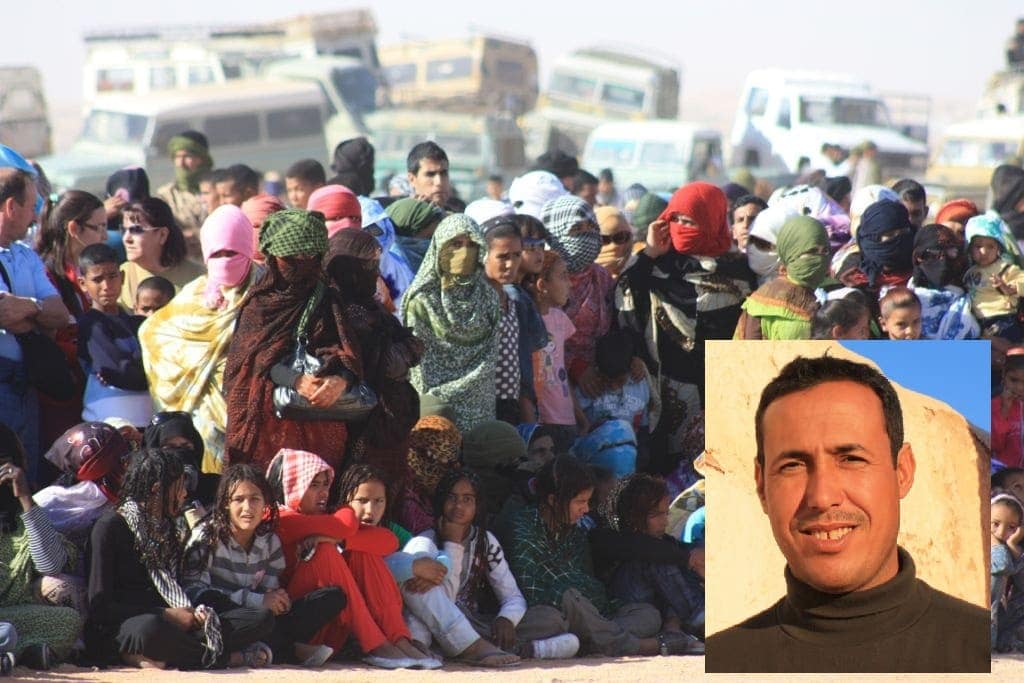
Last week, the terre des hommes schweiz team received a visit from the Sahrawi refugee camp Smara. Zein Sidachmed, who is responsible for youth work on the ground, reported on the situation in the camps and expressed concern about the increasing frustration of the Sahrawi youth – a breeding ground for their radicalization.
Annette Mokler, Western Sahara Programme Coordinator
Since the occupation of Western Sahara by Morocco, the Sahrawi population in the refugee camps on Algerian soil has suffered from a lack of prospects, the poor supply situation and the harsh climatic conditions. The lack of prospects in the camps is particularly discouraging for young people. The Sahrawi Youth Organization (UJSARIO) is committed to the interests of the Sahrawi youth. terre des hommes schweiz supports the youth work of UJSARIO Smara in the Smara refugee camp (refugee population approx. 60,000). Zein Sidachmed is responsible for the youth work of UJSARIO Smara.
Frustration feeds radicalization
In an impressive lecture, Zein presented the work and situation of the Sahrawi youth in the camps. He clearly expressed his concerns about the Sahrawi youth, who are growing up in a very fragile context in the Sahara region. More and more young people are expressing great frustration about the stalemate in the Sahrawi cause: “They no longer believe that the referendum, which is supposed to decide on the self-determination of the Sahrawis, will ever be held.” Zein warns that it is still possible to calm the situation at the moment, but “a new generation is growing up that is so fed up with the lack and lack of prospects that it is ready to take up arms again to pursue its demands.” As long as there are no economic prospects, no paid dignified work and no prospects for a political solution, this trend will not change.
Warning against terrorism and the drug mafia
According to the youth worker, terrorist movements in the Sahara region and drug mafias in neighboring countries such as Mali, Mauritania and Morocco, which try to recruit young people who otherwise see no opportunities for their lives, who know how to move around in the desert and are used to a life of privation, also pose a great danger. In particular, he warned against supporting rebel groups, as the armed conflicts could also bring Islamist groups to power. Even if it is fundamentally positive that dictators are overthrown, there are dangers associated with the destabilization of systems.
Continuous support is important
The visitor repeatedly emphasized how important it is to protect the Sahrawi youth from these influences. The youth worker emphasized that the fact that the UJSARIO has been so successful so far is due in large part to the many years of continuous support from the donors of terre des hommes schweiz. As there are so many other necessities in the camps – maintaining a health system and water supply, providing food, etc. – there is hardly any other organization that takes care of the youth.
Exchange with European host families
In addition to the usual youth work, UJSARIO organizes the exchange of over 10,000 Sahrawi children with European host families every year. This allows the children to escape the unbearably hot summer months, when the thermometer climbs to 48 degrees Celsius, and the barren camp life for a short time and get to know other cultures. Zein Sidachmed is one of these children’s companions this year. He is using his stay in Europe to visit support groups. This includes terre des hommes schweiz in Basel.
Western Sahara – the unresolved conflict
Western Sahara was occupied by Morocco in 1975 following the withdrawal of the colonial power Spain. Around 150,000 Sahrawis fled from Moroccan attacks with napalm bombs on the civilian population to Algeria, where they have now been living for over 35 years in four refugee camps in the desert near the town of Tindouf. The Sahrawi liberation movement agreed to a ceasefire in 1991 on the condition that a referendum on the independence of Western Sahara be held. However, this referendum, which was called for by the UN, is still being blocked by Morocco to this day.