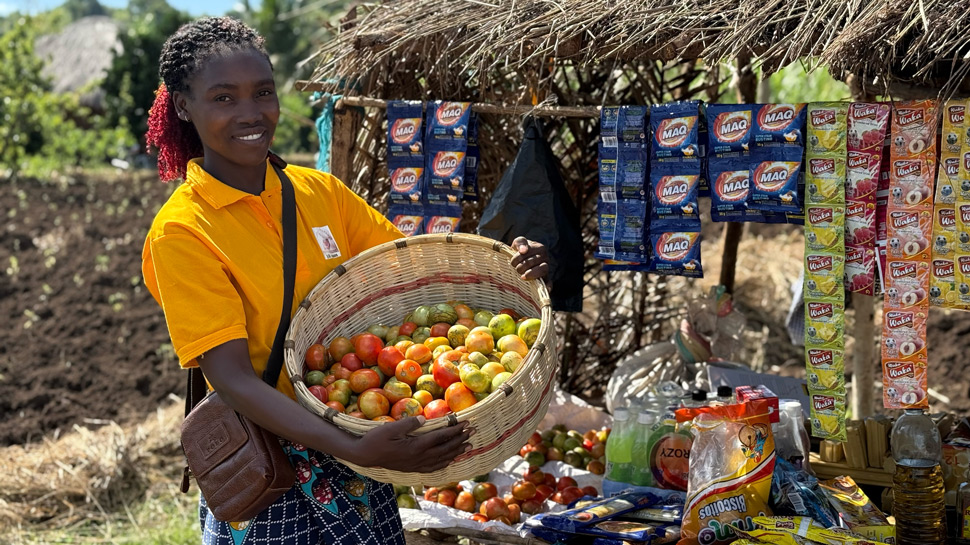
Genita Agaucheiro is proud: Since we first met in 2024, she has achieved great things. She built her first sales stand out of simple bamboo poles, and now the 25-year-old plans to use the profits from her sales to open a real store. Her story shows that courage and knowledge can pave the way out of poverty.
by Hafid Derbal, Program Coordinator, Mozambique
Every year, when I travel from Basel to Mozambique as a program coordinator, I think about which young people from the previous year I’d like to see again. I’m interested in how their situations have developed in the meantime. In May 2024, I had the opportunity to meet Genita for the first time at a training session organized by our partner organization, NANA. At the time, she told me what the training on setting up micro-businesses meant to her and what she hoped to gain from it. “As a farmer, I know how to grow vegetables. What I lack is the knowledge of how to market them effectively.” “I hope that after this training, I’ll be able to run my own business,” she said at the time. Those words have stayed with me, as have her motivation and confidence.
From a Street Stall to a Store
When I arrived, she was standing proudly in front of her little shop on the N1 highway, which connects Mocuba and Mugeba, two urban centers in the province of Zambézia in northern Mozambique. Every day, she walks the roughly half-hour journey here. But the location is ideal. In her shop, she offers drinks, snacks, and homemade pastries—everything that travelers and long-haul truck drivers appreciate. She also sells soap, fresh vegetables, and dried fish, which Genita sources from Mocuba and sells to the local population for a small markup. “This saves them a trip into town and allows me to sell more at the same time. I also sell my own produce, such as lettuce, cabbage, corn, and tomatoes. I started out with very little, but little by little I’ve been able to expand my selection and make more profit. It’s a blessing for me and my two daughters,” she says.
Young Mother in a Challenging Situation
Like many young women in Mozambique, Genita became a mother as a teenager. Her daughters are seven years and nine months old. More than half of the girls in the country have given birth to at least one child by the age of 18. This is the highest rate in Southern Africa and one of the highest in the world. Poverty and a lack of education often lead families to marry off their daughters at a young age. For many young mothers, it is then nearly impossible to escape poverty.
Mozambique is one of the poorest countries in the world. Nearly two-thirds of the population lives on less than $2.50 per day. Adolescents and young adults like Genita make up the largest demographic group, yet most do not have access to secondary or technical education. Every year, around 500,000 young Mozambicans enter the job market, mostly without training and without prospects. Young women are particularly affected by this.
Step by Step Out of Poverty
For NANA, one of terre des hommes schweiz’s six partner organizations in Mozambique, that is exactly what it’s all about: supporting young people—especially young women like Genita—to break the cycle of poverty. “What young people lack is a solid basic education and some startup capital,” explains Jeremias Benjamim, project manager at NANA. But in a rural area like the region around Mocuba, that’s easier said than done. A large portion of the population relies on subsistence farming and travels long distances to the fields every day. They have almost no savings. Most live from day to day. Children and adolescents are particularly vulnerable in this context. More than half of the young people in Mocuba are unemployed.
Teaching Important Skills
That is why it is important to create income opportunities related to agriculture. The basic training for young farmers at NANA covers not only improved production, preservation, and storage, but also basic knowledge about marketing their products. Genita also confirms just how crucial this is: “All I knew how to do was grow crops. But I didn’t learn how to sell them and make good use of the money until I joined NANA. It’s important to know how much you can spend on household expenses, how much you need to invest in your stall, and how much you should save.”
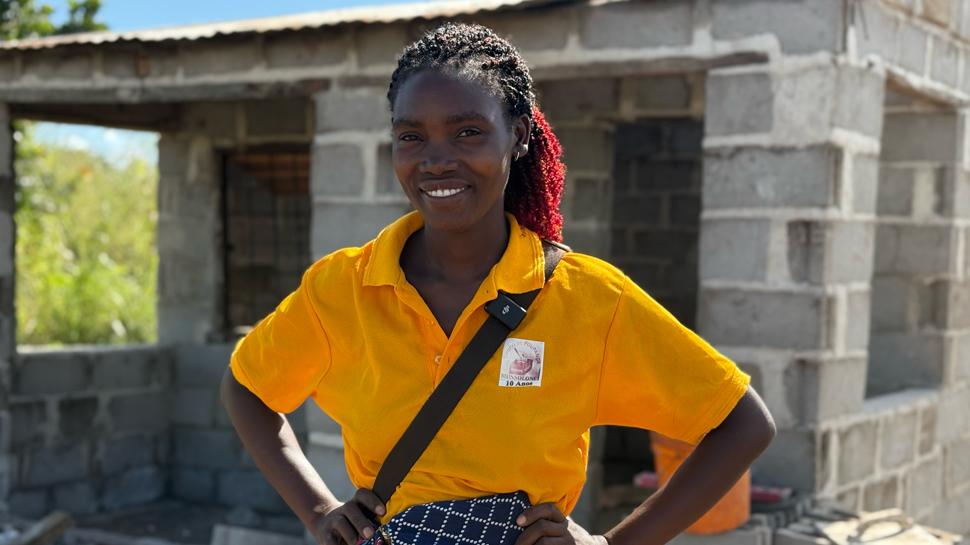
She points to a small concrete building and smiles. That will be her new store. The grand opening is coming up soon. The store will not only spare her the daily trip of transporting goods to the market stall, but will also provide secure storage and allow her to sell her goods in any weather. In a region particularly hard-hit by the effects of climate change, this is of great importance, as Jorge Cardoso, director of NANA, also knows. “In times of the climate crisis, we encourage young farmers not only to practice agroecological and climate-resilient farming. It’s also important that, when building small structures like shops or warehouses, they use resilient and sustainable materials as much as possible to be better protected against cyclones and storms,” he says.
Pass on what you’ve have learned
When asked what she hopes for the future, Genita explains that she has started a savings group with other young women from her village. Their goal is to help more women gain access to startup capital. “I want to show them that it’s possible. I know exactly what it feels like to think you have no chance of changing your situation. You need someone to reach out and help you. I want to give back what I’ve received,” she says.
Genita also plans to share her knowledge with others and inspire young women in her community to take action themselves. By combining agricultural expertise, business management skills, and a sense of community, she hopes to build a network of independent women over the long term. In this way, her work will not only be a personal success but also serve as a model for the entire region.
Your sponsorship makes a difference
By becoming a sponsor, you empower young people and open up new opportunities for them. Support a cause that is close to your heart—such as girls and women. Through this sponsorship, you can empower girls and young women like Genita and give them access to legal, psychological, and financial support.