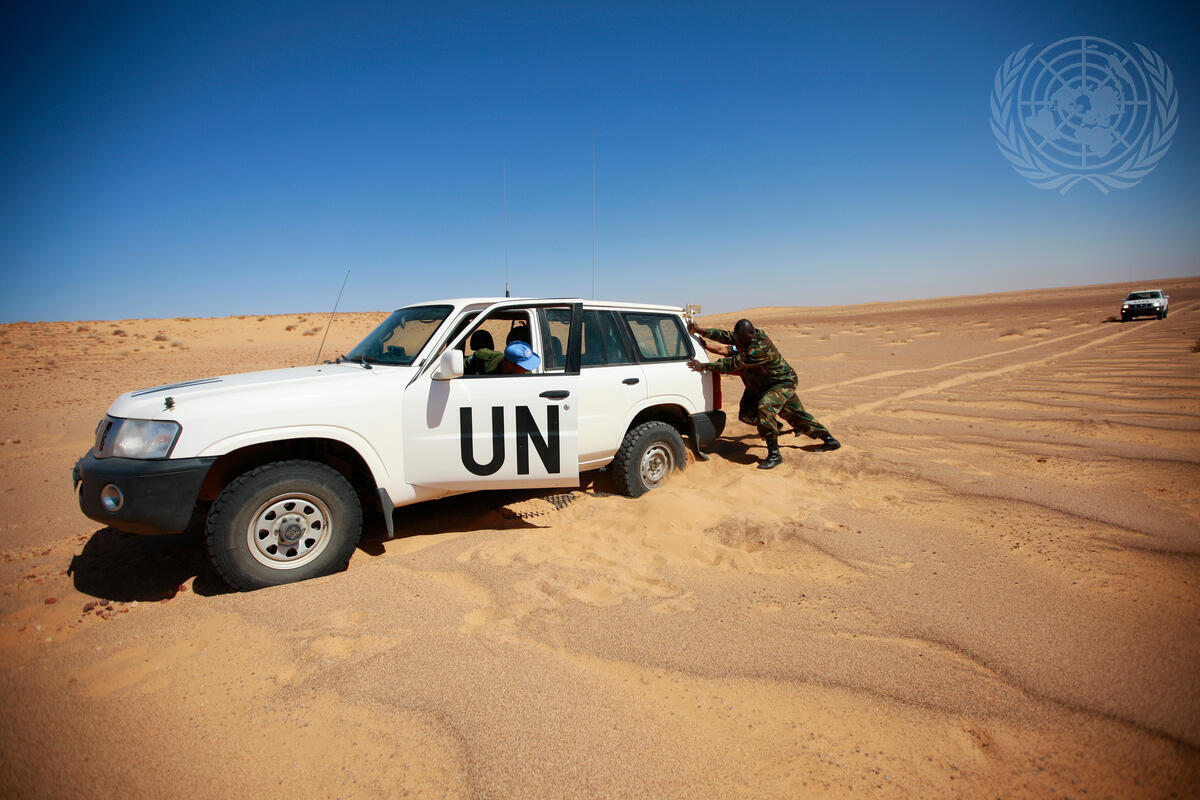
The UN Security Council did not extend the mandate of the MINURSO peacekeeping mission in Western Sahara at the end of October 2026. What happens next remains uncertain at this time. terre des hommes schweiz continues to advocate for the self-determination of the Sahrawi people.
On October 30, 2026, the UN Security Council voted on the extension of MINURSO’s mandate, as it has done every year since 1991. The peacekeeping mission for Western Sahara has so far monitored the ceasefire between the Polisario Front and Morocco and was tasked with organizing a referendum in which the Sahrawi people could exercise their right to self-determination.
From MINURSO to MINUSO?
This year’s vote in New York was anticipated with particular anticipation. The resolution also sets the political course for the peace process in the conflict that has been ongoing since 1975. The resolution is drafted by the U.S. each year—in 2026, the proposal would have had far-reaching consequences. Specifically, it called for removing the “R” for “referendum” from the mission’s name and, with it, its mandate to conduct one. The resolution also designated the autonomy plan unilaterally proposed by Morocco as the sole basis for negotiations between the parties to the conflict. This stands in clear contradiction to the international right to self-determination of the former Spanish colony of Western Sahara.
What the Western Sahara Conflict Is About
Two-thirds of the former Spanish colony of Western Sahara has been occupied by Morocco since 1975. Since then, approximately 174,000 Saharawis have been living in refugee camps in southwestern Algeria, while those who remained in their homeland face severe repression in the occupied territory. Western Sahara has UN status as a non-self-governing territory. Since 1991, the people have been waiting for a referendum to be held in which they can decide their own future. Read more.
Unprecedented Confrontation in the UN Security Council
At 4 p.m. local time, a dramatic and unexpected confrontation took place in the Security Council: Eleven Council members voted in favor of the U.S. resolution, while three abstained. Russia not only abstained—as it has done for years—but also exercised its veto. A draft resolution from Russia, which had been made public shortly before, was subsequently blocked by the U.S. The brief Russian proposal called for a one-year extension of the MINURSO mandate, as is customary, supported negotiations in accordance with the UN Charter—including the right to self-determination—and contained no reference to Morocco’s autonomy proposal.
Termination of MINURSO
With the mutual deadlock, MINURSO’s mandate expired on October 31, 2026, after 35 years. Immediately following the vote, Morocco declared that the Western Sahara issue was no longer a matter for the UN and demanded the mission’s withdrawal from the territory. On November 1, 2026, UN Secretary-General António Guterres confirmed the dissolution of the UN mission for Western Sahara.
Uncertain Future
It is unclear what will happen next. A short-term extension of the mandate was considered a possibility, but the chances of that have dwindled following the Secretary-General’s statement. Meanwhile, the work of the UN Special Envoy for Western Sahara, Staffan de Mistura, continues, as Guterres also confirmed. Without MINURSO, however, his position is significantly weakened. Guterres, however, “reaffirms the United Nations’ commitment to supporting the parties in reaching a just, lasting, and mutually acceptable political solution that guarantees the self-determination of the people of Western Sahara.”
The U.S. draft resolution would have been disastrous. The principle of continuing negotiations solely on the basis of the Moroccan autonomy plan would have effectively ignored the Sahrawi people’s right to self-determination. Following the vote, a number of statements from countries that voted in favor of the U.S. resolution in the Council were also perplexing and not very encouraging: They regretted its rejection but supported the right to self-determination—a contradiction to the Moroccan autonomy plan as the sole basis for negotiations. Switzerland’s position on this issue is also becoming increasingly unclear, as an official statement from April 2026 shows.

“The end of MINURSO does not mean the end of the Sahrawi people’s right to self-determination. We also call on Swiss policymakers to clearly commit to this principle and not to favor any unilateral proposed solution.”
Sylvia Valentin, Development Policy Campaigns, terre des hommes schweiz
For many years, the annual renewal of MINURSO’s mandate was negotiated by the “Group of Friends of Western Sahara”—France, Spain, the United Kingdom, Russia, and the United States—prior to each vote and adopted unanimously. Since 2018, however, this system has been crumbling. Since then, Russia has abstained from the vote, and China followed suit in 2025. The escalation even before the vote, Russia’s counterproposal, and the rejection of both resolutions mark an unprecedented break with tradition.
The right to self-determination remains unaffected
The legal framework governing Western Sahara has not been abolished. Western Sahara retains its UN status as a Non-Self-Governing Territory. It remains on the list of unresolved colonial conflicts whose decolonization has not been completed. The 1975 ruling of the International Court of Justice, as well as numerous rulings by the European Court of Justice (ECJ) that treat Western Sahara and Morocco as separate territories, remain valid.
Sidi Omar, the Polisario’s representative to the United Nations, stated on November 1, 2026: “As the UN Secretary-General has emphasized, the withdrawal of MINURSO does not nullify the inalienable rights of the Sahrawi people.” Omar also reaffirmed “its [the Polisario Front’s] unwavering commitment to cooperating with the United Nations Secretary-General and the UN Security Council in the search for a just, lasting, and definitive solution for the decolonization of Western Sahara, Africa’s last colony.”
We’ll see how things unfold in the coming days and weeks.