
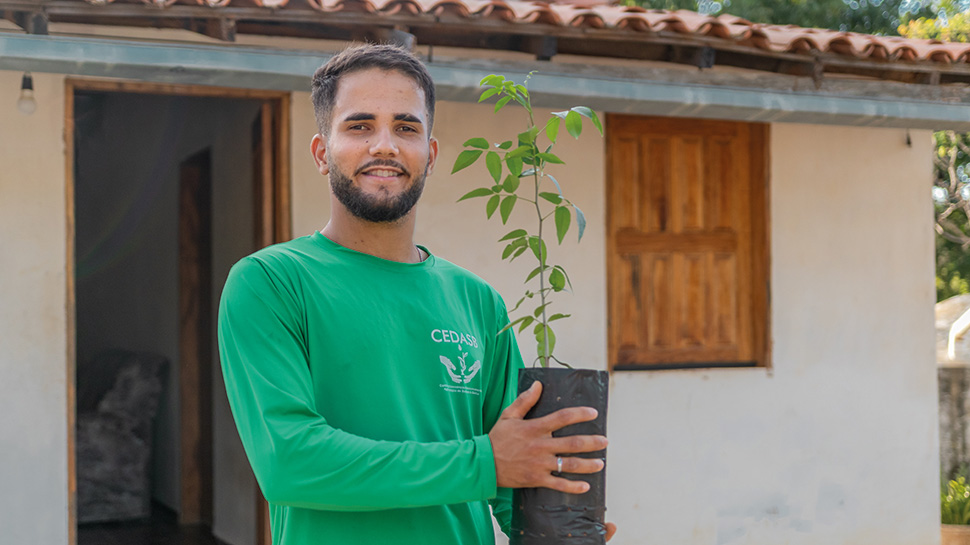
In Márcio Silva Joares’ home country, which is characterized by water scarcity, being a farmer is a major challenge. But the 20-year-old has a clear vision: he wants to stay on his family’s farm, adapt it to the consequences of climate change, make a living from his produce and at the same time strengthen nature and the community. He has learned a lot about biodiversity, innovative farming methods and marketing in our practical courses.
Márcio Silva Joares is proud of his own seedlings. He carefully tends to every single plant in his nursery. “All the varieties are indigenous and well adapted to the semi-arid climate in my home country. When I sell them on the market, I can support my family with the income.” And at the same time slow down the advancing desertification and contribute to the regeneration of his environment.
The now 20-year-old lives with his mother in Bom Sucesso on the small piece of land that belongs to the family. His siblings have already moved away. But he wants to stay on the farm, even though life in Bahia’s southwest is particularly demanding for young people. In this rural region, there is hardly any education, hardly any jobs and the land available to small farmers is small.
Conscious use of your own resources
“We keep pigs and chickens,” says the young farmer, “and grow vegetables, beans, maize, andu – a legume – cassava, lettuce and various fruits.” These dryland crops are agricultural crops that require little water. “As rain is rare here, we can only grow some crops during the short, four-month rainy season,” explains Márcio.
The conscious use of this precious resource is therefore all the more important. A cistern has recently been installed to store water to bridge the dry season. And he has learned how to collect and reuse rainwater and even gray water.
Climate change is particularly noticeable in the semi-arid east of Brazil, where the state of Bahia is located. Low rainfall is causing desertification to progress. Deforestation, export-oriented agricultural policies, extensive cattle farming and large-scale monocultures are exacerbating the situation. Small farmers like Márcio – who produce 70 percent of the local food requirements – feel these changes in their everyday lives. Knowing adaptation strategies and sustainable cultivation methods is therefore essential.
Sustainable agriculture as a perspective
“If we protect nature, it helps the climate,” emphasizes the young farmer. “I don’t want to go to the city just because I can no longer live off our land or because I don’t have the knowledge to make the most of it. My home is here.” Organic farming, which is adapted to the semi-arid region, creates this perspective: it ensures self-sufficiency, creates food security, enables additional income and also mitigates the consequences of climate change.
Practical support
The young smallholder has learned a lot about what is important in cultivation, how to select and care for which plants and why biodiversity is important in the training courses run by our partner organization CEDASB. But also how to process and market the products: “I learned a lot about climate change, about sustainable agriculture and the circular economy. I also learned how important ecological areas are and what young farmers can do to protect nature. I realized that we young people play a central role in protecting our environment,” he adds. He adds: “If we young people don’t see any prospects in the countryside and migrate, there will be a lack of farmers who produce our food – in an environmentally friendly way – and reforest the forest with their seedlings and thus stop desertification.”
Processing and added value
Today, Márcio relies on modern agroforestry systems, a mixed culture of native trees, animals and crops. He sells his pesticide-free food at the local weekly market. His organic fertilizer comes from his animals, which live under shady trees and on a plant-based diet – free of charge. “That’s good for people and the environment,” says Márcio. Many of the harmful agrochemicals commonly used in Brazil are banned in Switzerland or the EU because they have been proven to pollute the environment and groundwater.
In the dry season, he processes his harvest. He makes flour from maize and manioc, jam from the fruit and sausages and other meat products from pork. Selling fresh and processed food allows Márcio to earn an income all year round.
Shaping the future with visions
His own nursery is his latest project. He uses the seedlings to promote biodiversity at home and create another source of income. “I want my nursery to thrive and grow. That’s why I’m constantly learning.” Márcio already has the next idea. “I want to become a beekeeper and breed my own bees.” These should not only provide honey, but also improve the pollination of his fields and thus further strengthen the community. So the 20-year-old is continuing to build his future and that of his home.
Donate now to give young people like Márcio a future in the countryside
Together with CEDASB, terre des hommes schweiz supports farmers in the dry southwest of Bahia in sustainably improving their food production and the use of scarce water for irrigation and personal use. The practical courses are supplemented by start-up aid such as seeds or tools and ongoing advice. This enables them to use innovation and commitment to adapt their small family farms to the consequences of climate change and create a future worth living for themselves and their community in the long term.