The mango trees in Mocuba, Mozambique, are not only used for cooking – they are also a source of hope. With simple means and knowledge, Catia Lucas Armindo turns bananas and pumpkins into income. Her goal: to feed her own family and show other young women the way out of poverty. A workshop that is more than just a cooking course.
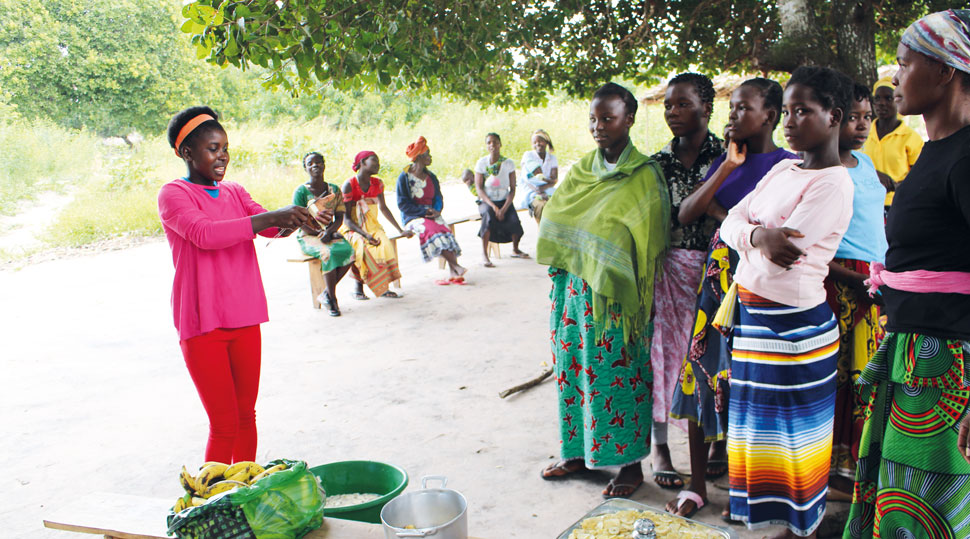
Catia Lucas Armindo has prepared everything under the mango trees: Pots, colanders, knives and chopping boards, sunflower oil, salt and, of course, bananas. Pumpkins, water, sugar and spices are neatly arranged in another area of the improvised kitchen. Today, she wants to pass on her knowledge of how to use and market them to young women from the rural area of Mocuba. At the age of 19, she does not consider herself an expert, but she already has the necessary practical experience that her course participants lack.
“Bananas and pumpkins grow well here. The harvest is usually abundant, but a lot goes to waste or ends up in the cattle trough because it can’t be sold fresh,” says Catia, who lives with her mother and five siblings. She learned how to preserve and process various products during a short training course run by Núcleo dos Amigos da Natureza e Ambiente (NANA), one of our six partner organizations in the Mozambican province of Zambezia. She is now showing other young women how to make long-life products from the harvest – and thus feed their families.
Knowledge transfer through South-South cooperation
“That’s the deal we make with many young people,” says Jorge Cardoso, Director of NANA. “When they attend our training, they are expected to pass on what they have learned later. Our experience shows that they are usually motivated to give the new knowledge back to their communities. Solidarity is very important in rural areas.”
This also applies to NANA. During a study trip to Brazil two years ago, he and two of his colleagues were able to visit various initiatives and take away many inputs that they are now successfully implementing in Mozambique. “Such moments of exchange are also essential for our non-profit organization. We are glad to have partners like terre des hommes schweiz who support such exchanges!”
Practical and profitable
Today’s workshop is very practically organized. Catia explains and demonstrates the individual steps. All the participants join in straight away. The plantains are turned into crispy chips; they are very popular with day laborers and long-distance drivers. Not much material is needed. They can only be sold for a small profit, but in large quantities. The pumpkin jam brings in more, but the effort is greater and the materials are more expensive. Above all, however, your own harvest does not simply rot, it is preserved.
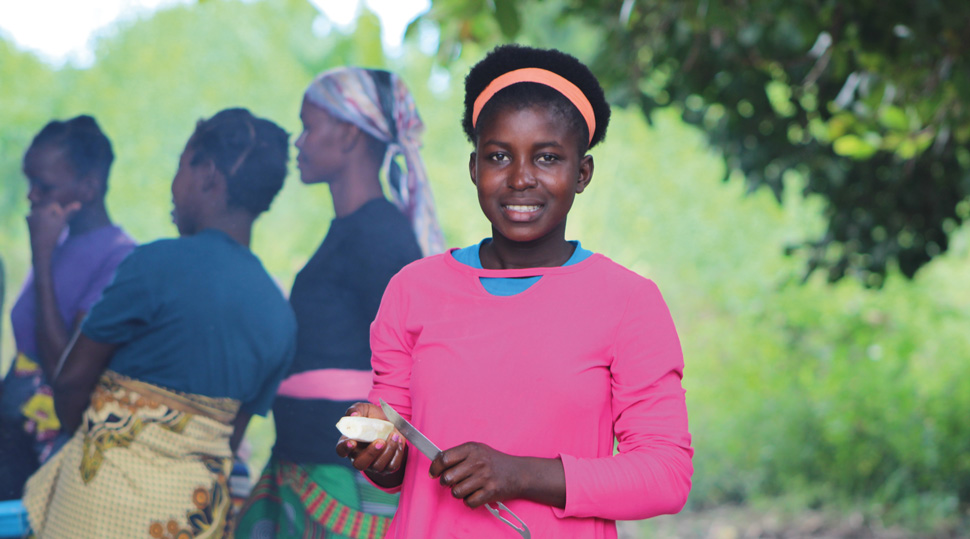
The young woman is thus able to generate welcome cash for her family of six, who have been living in precarious circumstances since the death of her father a few years ago. She uses the money to buy basic foodstuffs that they do not grow themselves or to pay for her younger siblings’ schooling.
Hardly any prospects in the countryside
Catia’s situation is not an isolated case. The absence of a father, and therefore the main breadwinner, can drive entire families further into a spiral of poverty. Mozambique is one of the poorest countries in the world. Almost two thirds of the population live in extreme poverty on less than two francs a day and have hardly any savings. The majority of the 30 million Mozambican women live in rural areas and many are small-scale farmers. They live from subsistence farming – growing food for their own needs. At the same time, they are vulnerable to natural disasters such as floods, cyclones and droughts, which are becoming more frequent and more severe in the south-east African country due to climate change.
Children and young people are particularly vulnerable. Young people like Catia belong to the largest age group in Mozambique. A lack of schooling and access to technical or university education remain a major challenge. In the district of Mocuba alone, more than half of young people are unemployed. Every year, around 500,000 young Mozambicans join the labor market, mostly without training or prospects. This is especially true for young women.
Solidarity and further training strengthen communities
Our partner organization NANA supports young adults, especially young women, in breaking this spiral of poverty. “What many young people lack is a solid basic education and some start-up capital,” explains Jeremias Benjamim, project manager at NANA. This is easier said than done in a rural region like around the town of Mocuba. That is why it is important to create income opportunities related to agriculture. NANA’s basic training for young female farmers revolves around improved production, preservation and storage, as well as simple but elementary things to do with marketing produce.
Catia really enjoys doing this training: “I can see myself in many of the young women. I didn’t have much knowledge back then either. The training has helped me a lot because I can sell the bananas all the time. Now I want to help my family and my community. Because together we are strong.”
Donate now,
so that young people can get started.
Together with our local partner organization NANA, we support over 1,000 young people every year with training in sustainable agriculture, among other things. We strengthen their knowledge of how to process their home-grown produce and support them in marketing it. So that young people like Catia can improve their livelihoods and build a future for themselves.
The work with and by NANA contributes to three goals of the United Nations 2030 Agenda for Sustainable Development (SDG): Goal 1 “No Poverty”, Goal 2 “Zero Hunger” and Goal 5 “Gender Equality”.