Ten million people, almost a quarter of the Ukrainian population, are on the run, with hundreds of thousands more to follow. The solidarity that the refugees are experiencing is enormous. European cooperation with the aim of taking in refugees is suddenly possible; in Switzerland, protection status S is being activated. A classification from our point of view at a time when events are coming thick and fast.
Armed conflicts, violence and poverty are the main reasons why people flee. The fact that they are now fleeing to Switzerland not just from Syria or Eritrea, but from a European country, is an opportunity to be more careful in distinguishing between “genuine” and “non-genuine”, between political and “economic refugees”. Let us hope and work to ensure that solidarity with refugees continues and also applies to people who have fled from other regions of the world.
Once the first basic needs such as safety, shelter and food have been met, the next step will be to provide these people with psychological and psychosocial support, to give them a meaningful daily structure and to give some of them a long-term future in Switzerland. This month, more than 500 medical and psychotherapeutic professionals drew attention to the importance of enabling refugees to live in dignity in the long term in an open letter to politicians and authorities co-initiated by terre des hommes schweiz.
Food for thought from the perspective of the culture of peace
This recent war in Europe is a stark reminder of the unspeakable suffering, senseless destruction and brutality of armed conflict. terre des hommes schweiz is committed to promoting a culture of peace in Colombia, Brazil and El Salvador. Solidarity with all those affected by violence and war is our top priority.
The war against Ukraine is a political and humanitarian catastrophe for the whole of Europe, a crime against humanity. The values of non-violence and peace are fundamental to our work. The confrontation with violence and war repeatedly forces us to reflect on ourselves and leads to serious dilemmas. In the extremely complex process of weighing up the value of non-violence and the right to self-defense, we do not expect ourselves to have any easy answers.
Look where it hurts
However, especially in the face of armed violence, it is important to differentiate points of view and make non-violent alternatives more visible. Simple reflexes of the arms race are not a solution to the complex security and peace policy challenges of our time.
An important basic principle of a culture of peace is the ability to change perspective and self-criticism. The brutal war of aggression makes it clear that Swiss politicians have turned a blind eye to the close economic relations with the Putin regime for too long. Criteria of democracy and human rights have too little weight in economic relations. Switzerland must now confront the painful realization: For too long it benefited from corrupt oligarchs and the Russian commodities trade and enabled the authoritarian regime’s business dealings.
Despite everything – signs of hope
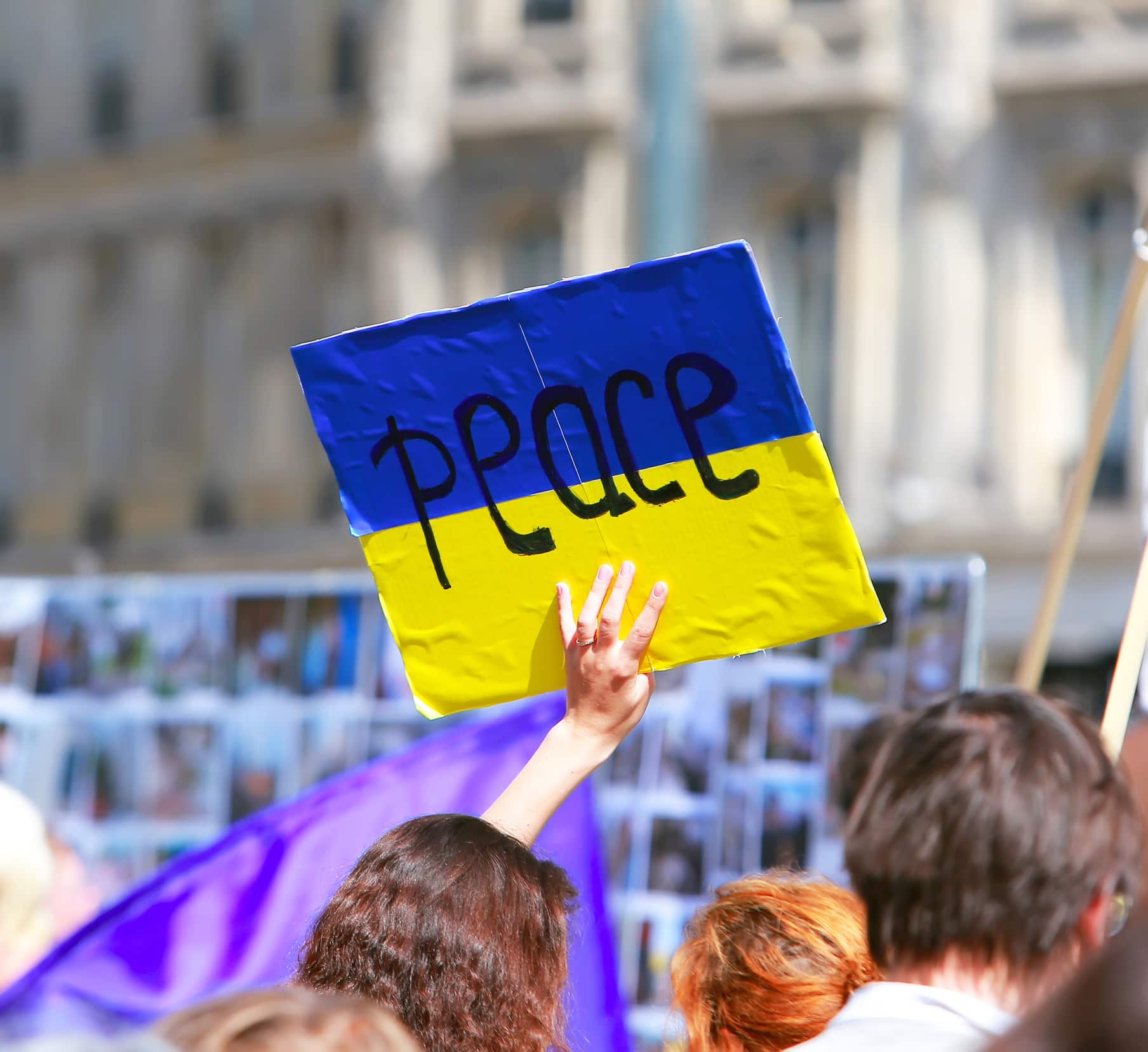
It gives hope to see how millions of people around the world are taking to the streets for peace and how tens of thousands are mobilizing in peace demonstrations in Switzerland too. They are venting their powerlessness and horror and showing how basic values of democracy and peace can unite people. The immense solidarity for the refugees is a clear sign that the values of humanity are deeply rooted and make us capable of acting as a civil society.
Active against powerlessness
Young people with a refugee background have a lot to cope with in Switzerland. A lack of employment due to their residence status, existential fears about the future and separation from their families all contribute to a negative spiral of thoughts.
In the “MePower” project, we have been actively working with those affected in Basel since 2019. During the workshops and meetings, the young people become aware of their strengths and abilities instead of focusing on problems. They also learn about the central processes and contact points relating to the Swiss asylum system.
In this way, we are creating an urgently needed service in the area of psychosocial support for refugees. It addresses issues such as isolation, disorientation and confrontation with prejudice and exclusion.
Based on several years of project work, we are currently developing a program for young people from Ukraine that is tailored to their specific needs. You can support the “MePower” project with a donation. Thank you very much!